The Nervous System Case for Self-Compassion... and How it Will Help You Stop Over-Eating

Jul 23, 2026
 The Nervous System Case for Self-Compassion... and How it Will Help You Stop Over-Eating

For most of my life, eating felt like a constant negotiation.

A quiet, relentless vigilance running in the background.

What did I eat?
What should I eat?
Did I already eat too much?
Will I “be good” tomorrow?

Even when I wasn’t actively dieting, I was managing.
Monitoring.
Correcting.

It felt like a battle I had to win every single day.

Sometimes I did “win.”
And sometimes I didn’t.

But even on the days I “won,” I was tense. On guard.

It wasn’t freedom or the life I dreamed of.
It was surveillance.

Eventually, the pendulum would swing.


What Most People Do

When over-eating feels out of control, most people try to control harder.

They:

  • Get the foods they love out of the house
  • Cut out sugar or carbs completely
  • Start over Monday
  • Or try medical interventions - GLP-1s, stomach-shrinking surgery.

At first glance, these strategies make sense.

If food is the problem, remove the food.
If appetite is the problem, suppress it - beat it into submission.
If willpower isn’t working, make it physically impossible to willpower isn’t necessary.

I’ll admit, even after years of a healed relationship with food, I feel tempted by the rush of clearing out my kitchen of all the “bad” foods when I write about it. That doesn’t sound fun, I know… but when it came with the hope of skinny dreams fulfilled, it was pretty dang exciting. 

All these strategies are band-aids.

And when the band-aid falls off, the wound underneath is still gaping.

Often worse than before you covered it in the first place.

Because now you’ve added:

  • Shame
  • Distrust
  • Even more fear around food
  • And often increased biological hunger.

The real issue was never just the food.


Why Your Nervous System Matters More Than Willpower

According to Polyvagal Theory, your nervous system is always asking one question:

Am I safe? 

And depending on the answer, it shifts into different states that directly impact your eating.

Sympathetic (Fight / Flight)

This is urgency. Vigilance. “I need to fix this.”

Restriction lives here.
Food rules live here.
Starting over Monday lives here.

When you’re in this state, your body is mobilized and bracing. Survival comes first — not subtle fullness cues.

A body that feels threatened will seek resources. That’s biology, not failure.


Parasympathetic — Ventral Vagal (Safety)

This is where connection, digestion, and regulation happen.

Hunger cues live here.
Fullness cues live here.
Satisfaction lives here.

Your body needs safety to accurately feel “I’ve had enough.”
Digestion itself only functions optimally in this state.

No safety = no clear signals.


Dorsal Vagal (Shutdown)

This is numbness. Collapse. Disconnection.

Sometimes over-eating isn’t urgency — it’s exhaustion.
It’s “I don’t care.”
It’s emotional depletion.

Food can temporarily bring you out of shutdown. It can stimulate and soothe at the same time.

So again — this isn’t a willpower problem.
It’s a nervous system pattern.

Restriction activates threat.
Shame activates threat.
Harsh self-talk activates threat.

Self-compassion signals safety.

And safety is what allows your body to actually regulate.

This Is Where Self-Compassion Comes In

Self-compassion is not letting yourself “get away with it.”

It’s not giving up.
It’s not abandoning health.

It is nervous system regulation.

When you tell yourself:

“It’s okay to eat.” (in a calm and genuine way - NOT “F*** it I’m going to eat it”)

You are not giving in to chaos.

You are de-escalating your nervous system.

You are moving from:

  • Threat Safety
  • Scarcity Enough
  • Urgency Choice

And when you are in a ventral vagal parasympathetic state, you can actually feel:

  • Fullness
  • Satisfaction
  • Enoughness

You cannot feel full if you don’t feel safe.


In the Moment It Happens

When you feel the pull to eat, most people either:

  1. Clamp down (“Don’t do it.”)
  2. Engage with caution and negotiation (“okey here’s what I’m allowed to eat”)
  3. Or give in with reckless abandon and then punish themselves.

All of which keep you in sympathetic activation.

Here’s the shift:

Instead of fighting the urge or acting as your own master, try this:

Pause.
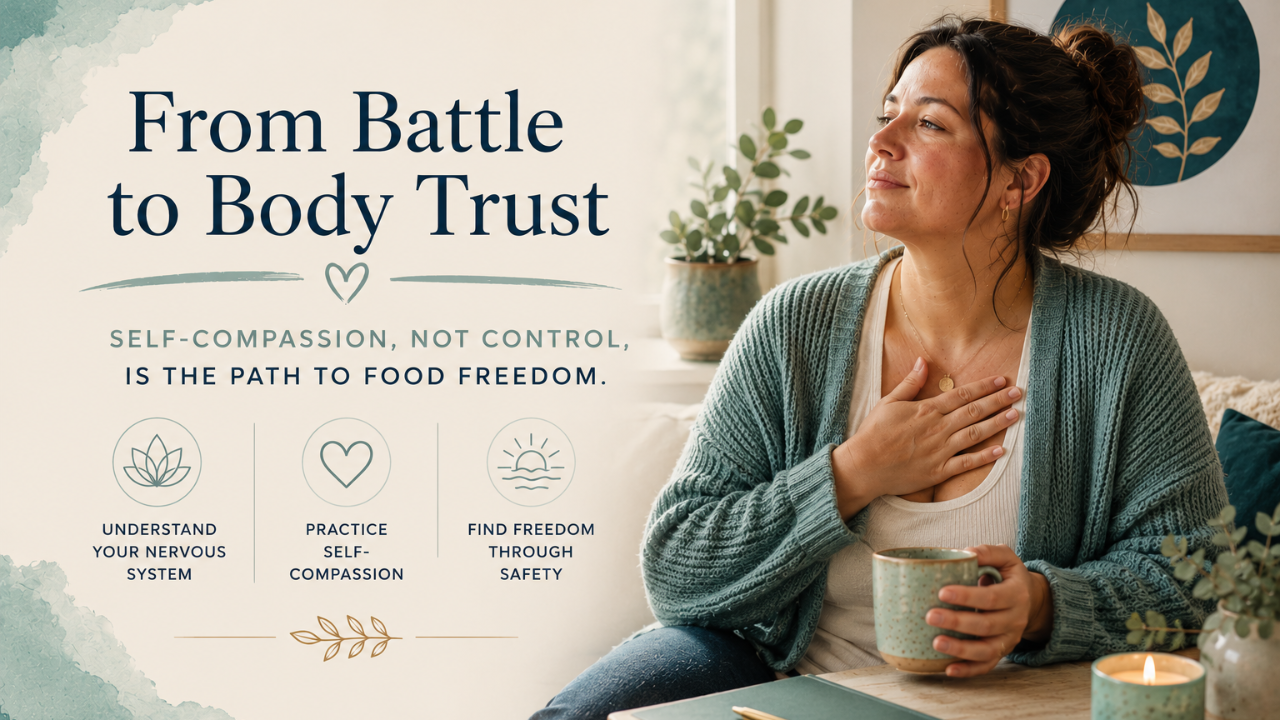
Place your hand on your body.
And say:

“It makes sense that I want to eat.”
“I’m allowed to eat.”
“I’m not in trouble.”

Notice what happens.

You are not meditating your way out of hunger.
You are not gaslighting your body.

You are removing the internal threat.

And often, once the threat is gone, the urgency softens leaving you with an actual choice.

Sometimes you’ll still eat.
Sometimes you’ll choose less or different food.
Sometimes you’ll realize you wanted comfort, not food.

But either way, you are no longer at war.

Here’s the thing, you cannot have a secret agenda that this practice make you NOT eat. If you do that, you’re staying in threat mode.


The Bottom Line

The solution to feeling out of control with food is not tighter control.

It’s healing the wound underneath.

It’s moving your body out of constant vigilance and into safety.

Self-compassion heals.
Restriction suffocates.

One builds trust.
The other builds rebellion.

You don’t need more discipline.
You need more safety.

And safety begins with how you speak to yourself.

You deserve to eat without fear.
You deserve to feel full.
You deserve peace in your own body.

You are not a before story.

You are a human being with nervous system learning how to feel safe again.

And that is something you can practice — starting today.

Lorem ipsum dolor sit amet, consectetur adipiscing elit. Cras sed sapien quam. Sed dapibus est id enim facilisis, at posuere turpis adipiscing. Quisque sit amet dui dui.

Call To Action

Stay connected with news and updates!

Join our mailing list to receive the latest news and updates from our team.
Don't worry, your information will not be shared.

We hate SPAM. We will never sell your information, for any reason.

All The Tools You Need To Build A Successful Online Business

Lorem ipsum dolor sit amet, metus at rhoncus dapibus, habitasse vitae cubilia odio sed. Mauris pellentesque eget lorem malesuada wisi nec, nullam mus. Mauris vel mauris. Orci fusce ipsum faucibus scelerisque.

Call To Action

How Self-Compassion Will Help You Stop Over-Eating

For most of my life, eating felt like a constant negotiation.

A quiet, relentless vigilance running in the background.

What did I eat?
What should I eat?
Did I already eat too much?
Will I “be good” tomorrow?

Even when I wasn’t actively dieting, I was managing.
Monitoring.
Correcting.

It felt like a battle I had to win every single day.

Sometimes I did “win.”
And sometimes I didn’t.

But even on the days I “won,” I was tense. On guard.

It wasn’t freedom or the life I dreamed of.
It was surveillance.

Eventually, the pendulum would swing.


What Most People Do

When over-eating feels out of control, most people try to control harder.

They:

  • Get the foods they love out of the house
  • Cut out sugar or carbs completely
  • Start over Monday
  • Or try medical interventions - GLP-1s, stomach-shrinking surgery.

At first glance, these strategies make sense.

If food is the problem, remove the food.
If appetite is the problem, suppress it - beat it into submission.
If willpower isn’t working, make it physically impossible to willpower isn’t necessary.

I’ll admit, even after years of a healed relationship with food, I feel tempted by the rush of clearing out my kitchen of all the “bad” foods when I write about it. That doesn’t sound fun, I know… but when it came with the hope of skinny dreams fulfilled, it was pretty dang exciting. 

All these strategies are band-aids.

And when the band-aid falls off, the wound underneath is still gaping.

Often worse than before you covered it in the first place.

Because now you’ve added:

  • Shame
  • Distrust
  • Even more fear around food
  • And often increased biological hunger.

The real issue was never just the food.


Why Your Nervous System Matters More Than Willpower

According to Polyvagal Theory, your nervous system is always asking one question:

Am I safe? 

And depending on the answer, it shifts into different states that directly impact your eating.

Sympathetic (Fight / Flight)

This is urgency. Vigilance. “I need to fix this.”

Restriction lives here.
Food rules live here.
Starting over Monday lives here.

When you’re in this state, your body is mobilized and bracing. Survival comes first — not subtle fullness cues.

A body that feels threatened will seek resources. That’s biology, not failure.


Parasympathetic — Ventral Vagal (Safety)

This is where connection, digestion, and regulation happen.

Hunger cues live here.
Fullness cues live here.
Satisfaction lives here.

Your body needs safety to accurately feel “I’ve had enough.”
Digestion itself only functions optimally in this state.

No safety = no clear signals.


Dorsal Vagal (Shutdown)

This is numbness. Collapse. Disconnection.

Sometimes over-eating isn’t urgency — it’s exhaustion.
It’s “I don’t care.”
It’s emotional depletion.

Food can temporarily bring you out of shutdown. It can stimulate and soothe at the same time.

So again — this isn’t a willpower problem.
It’s a nervous system pattern.

Restriction activates threat.
Shame activates threat.
Harsh self-talk activates threat.

Self-compassion signals safety.

And safety is what allows your body to actually regulate.

This Is Where Self-Compassion Comes In

Self-compassion is not letting yourself “get away with it.”

It’s not giving up.
It’s not abandoning health.

It is nervous system regulation.

When you tell yourself:

“It’s okay to eat.” (in a calm and genuine way - NOT “F*** it I’m going to eat it”)

You are not giving in to chaos.

You are de-escalating your nervous system.

You are moving from:

  • Threat → Safety
  • Scarcity → Enough
  • Urgency → Choice

And when you are in a ventral vagal parasympathetic state, you can actually feel:

  • Fullness
  • Satisfaction
  • Enoughness

You cannot feel full if you don’t feel safe.


In the Moment It Happens

When you feel the pull to eat, most people either:

  1. Clamp down (“Don’t do it.”)
  2. Engage with caution and negotiation (“okey here’s what I’m allowed to eat”)
  3. Or give in with reckless abandon and then punish themselves.

All of which keep you in sympathetic activation.

Here’s the shift:

Instead of fighting the urge or acting as your own master, try this:

Pause.
Place your hand on your body.
And say:

“It makes sense that I want to eat.”
“I’m allowed to eat.”
“I’m not in trouble.”

Notice what happens.

You are not meditating your way out of hunger.
You are not gaslighting your body.

You are removing the internal threat.

And often, once the threat is gone, the urgency softens leaving you with an actual choice.

Sometimes you’ll still eat.
Sometimes you’ll choose less or different food.
Sometimes you’ll realize you wanted comfort, not food.

But either way, you are no longer at war.

Here’s the thing, you cannot have a secret agenda that this practice make you NOT eat. If you do that, you’re staying in threat mode.


The Bottom Line

The solution to feeling out of control with food is not tighter control.

It’s healing the wound underneath.

It’s moving your body out of constant vigilance and into safety.

Self-compassion heals.
Restriction suffocates.

One builds trust.
The other builds rebellion.

You don’t need more discipline.
You need more safety.

And safety begins with how you speak to yourself.

You deserve to eat without fear.
You deserve to feel full.
You deserve peace in your own body.

You are not a before story.

You are a human being with nervous system learning how to feel safe again.

And that is something you can practice — starting today.